
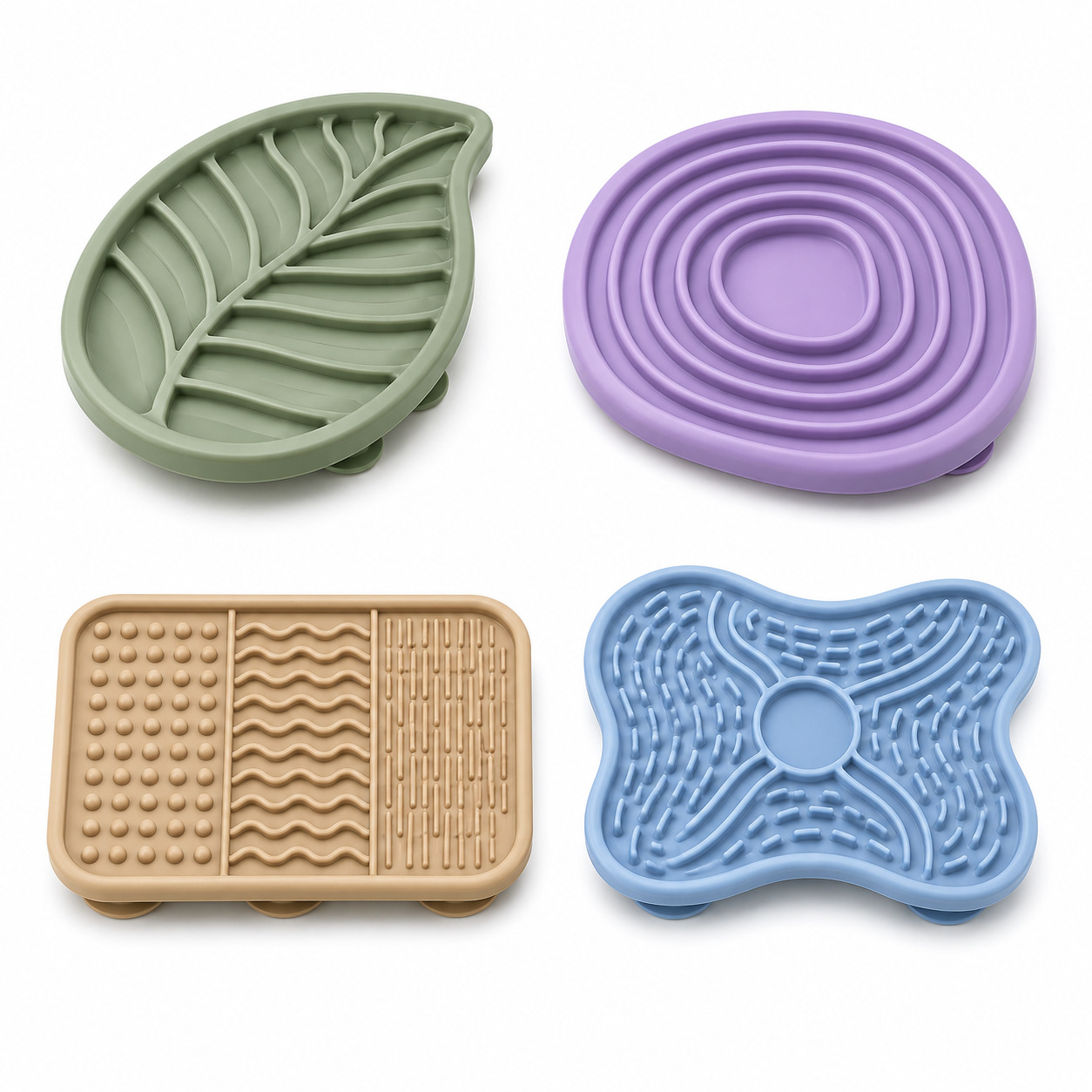
ATLAS 01 / CLASSIFICATION
A pet lick mat slow feeder pad sits in a regulatory gap. It is not food for human consumption, not a children’s toy, and not a medical or veterinary article. In the United States there is no single federal safety standard written for pet bowls, mats or feeding accessories; the FDA food-contact framework is built around food for human consumption, and the CPSIA children’s product rules apply to children’s products, not pet products. That does not mean the article is unregulated. California Proposition 65 reaches the pigments used in colourants, the FTC reaches what a listing claims, and a consumer safety regulator can still act on a product presenting an unreasonable risk of injury under general defect authority. The practical consequence is that the US gives a brand freedom and transfers the risk to its own wording: whatever is promised has to be substantiated.
In the EU the gap is filled by Regulation (EU) 2023/988, the General Product Safety Regulation, applicable since 13 December 2024. Pet accessories have no sector-specific rule, so they fall inside it. A manufacturer must run an internal risk analysis covering normal use and foreseeable misuse – for a pet article that explicitly includes chewing and pulling – keep technical documentation, identify the batch, put manufacturer and importer details on the product or packaging, provide safety information in the destination language, and have an economic operator established in the Union answering for the product under Article 16. Online listings carry the same safety information as shelf products. REACH Annex XVII restrictions and the SVHC candidate list apply to the materials themselves.
Two boundaries are worth writing into the brief. First, a pet product is not a toy under EU toy law, which is defined by play value for children; but a pastel, cartoon-faced design in a gift box invites the argument that the Toy Safety Directive should be assessed. Second, EU food-contact law under (EC) 1935/2004 governs materials contacting food for human consumption, so a declaration of EU food-contact approval for a pet mat describes a voluntary test, not a legal status. Our US document map and the compliance selection filter show how we keep a request list separate from a declaration. Classification is decided by the importer of record and qualified advisers, never by us.
ATLAS 02 / TEXTURE AND GEOMETRY
Wholesale buyers of a pet lick mat slow feeder pad are buying a mould, a compound and a pack. The face is specified as a pattern family and a geometry: ridge height, cell wall, tip radius, corner radius, panel thickness and the durometer band agreed on the approved sample. Multi-zone faces combine two or more pattern families on one mat, which changes the mould, the release behaviour and the cleaning check. None of these needs a story about mood or behaviour to be sellable – and adding that story is what turns a straightforward accessory into a claim the brand has to defend.
The back is a separate specification. Suction cups may be moulded integrally with the panel or added as a separate component; a separate cup is a potential detached small part, and the 16 CFR 1501 small-parts cylinder is a sensible borrowed benchmark even though it is not mandatory for pet products. Other back formats use a continuous non-slip rim or a weighted edge. The brief should state which one, because it changes both the tooling and the inspection plan. A written specification sheet and a buying brief template are the two documents we ask a buyer to send first; a component-level brief helps when the face and the back come from different tooling.
Colour is a material decision, not a decorative one. Pigments are where Proposition 65 lead and cadmium exposure typically lands, and REACH Annex XVII entries on lead and phthalates reach rubber and plastic articles generally. A Pantone-matched colourway therefore needs its own compound reference, its own report reference and its own sample. Sample approval change control and the approval gates are what keep a changed pigment from quietly invalidating an older report.
ATLAS 03 / BILL OF MATERIALS
Silicone is described in supplier listings as one material. On a purchase order it is a compound grade with a cure system, a durometer band, a pigment lot, a mould and a finishing step. Platinum-cured and peroxide-cured compounds behave differently after post-cure: a pinch-and-twist check that shows a white stress line, or a persistent chemical odour when dry, points to a filler-loaded or under-cured compound. Those are observable inspection items. A blanket purity slogan is not. We ask for a resin lot reference, a dated report tied to the exact SKU and batch, and a written statement of which borrowed test method the report used.
Mould ownership decides whether the buyer is a brand owner or a reseller. A dedicated texture, a new panel outline or an exclusive colourway usually means tooling, and the tooling and artwork ownership should be settled in the contract before a sample is approved. The OEM, ODM and OBM distinction, custom manufacturing, private label routes and the branded-versus-generic range decision all start from that same question. We do not clear intellectual property rights, check trademark registers or give legal opinions; the buyer supplies the artwork and the authority, and the mould and artwork ownership is written into the order. Retail packaging is specified as its own line because the pack carries the warnings and the traceability mark.
ATLAS 04 / WORDING BOUNDARY
This is the part of the page that differs most from the supplier listings we reviewed. Ranking pages in this category routinely describe a textured silicone mat as relieving anxiety, calming a pet, reducing a behaviour by a percentage, supporting digestion, carrying a veterinary endorsement, delivering a clinical or therapeutic outcome, or extending feeding time by a fixed multiple. They also print agency approval badges, blanket certification statements and absolute material or durability promises. We write none of those. They are not specifications, and a claim a brand cannot substantiate is a liability rather than a selling point.
What replaces those claims is a checkable description: the pattern family, the compound reference, the back format, the pack, the document file and the inspection results. The FTC treats words such as a blanket purity or indestructibility statement as advertising claims that must be substantiated; a durable-looking article that fails in normal use is the fastest route to a misrepresentation argument. Pre-shipment inspection and first article inspection give a buyer evidence to write about instead of adjectives. For context, our insulated drinkware page and the portable blender page cover articles that genuinely sit in a human food-contact conversation; a pet feeding accessory does not inherit that framework, and the two should never share a document set.
ATLAS 05 / REQUEST MATRIX
Because there is no pet-specific product rule, the sensible approach is to borrow the benchmarks a serious retailer or a plaintiff’s expert would use, and to say plainly that they are borrowed. Commonly requested references include 21 CFR 177.2600 for repeated-use rubber articles, BfR Recommendation XV and LFGB sections 30 and 31 for silicone migration and sensory behaviour, EN 71-3 for element migration, ASTM F963 as a toy-standard benchmark, and the 16 CFR 1501 small-parts cylinder for anything that can break off. None of these is mandatory for a pet accessory. All of them are useful evidence when the report names the exact SKU, compound, pigment and batch and comes from an ISO/IEC 17025 laboratory.
Marketplace listings are part of the same file. Under the GPSR an online offer must carry the safety information a shelf product carries, and a platform can ask for the responsible person details, the product and batch identification, the reports, the label artwork, the warnings and an incident contact. If a requested paper is missing, the honest answer is to source it or pause the listing, not to improvise one. How we verify a certificate and the certificate-by-industry checklist describe the same discipline on electrical goods; here it applies to a much simpler article. US entry paperwork is a separate line, covered by the US entry guide and supply-chain documentation. ISO/TC 355 was established in 2025 to develop pet product safety requirements; nothing binding exists yet, and we do not present a future standard as a current certificate.
ATLAS 06 / INSPECTION
A pet lick mat slow feeder pad is a simple article with a disproportionately large returns problem. A dog can chew a ridge, pull a cup off, or tear an edge; a mat that retains residue in a deep cell creates a cleaning complaint; a colour that drifts between lots creates a marketplace variation claim. The golden sample is therefore checked against a written list, and the first article is released only when each line has an agreed acceptance window. We do not invent the numbers – the buyer sets them, or confirms them with the chosen laboratory and factory before production.
The gates are only useful if the file and the goods stay aligned. A pigment change, a new cup supplier or a switch in the printing method sends the sample back through approval. Change control, pre-shipment inspection and drawing-based parts sourcing are the three places where a drift is normally caught. Supplier-side checks are covered in factory verification and supplier qualification; none of that makes us the manufacturer or the laboratory. We request, compare and report against the brief.
ATLAS 07 / CONSOLIDATION
The commercial reason to buy a pet lick mat slow feeder pad range at wholesale is assortment: several face patterns, two or three size bands, a small set of colourways, one or two suction formats and a retail pack, often with a spreader or a spare part. Splitting that into separate suppliers means separate cartons, separate documents and separate invoices. Consolidating wholesale orders, consolidating production supply and multi-factory container consolidation describe how those lines are brought onto one buyer reference. A mixed range also makes the counting discipline more important: face, format, colourway, spare ratio and pack have to match the order before the carton is closed.
Mats are light, but a carton of moulded silicone is bulky and does not compress without changing the stack. That is where the freight conversation starts: carton dimensions, how the panels nest, and the resulting chargeable weight. A written case-pack specification, chargeable weight and the freight quote checklist should be settled before the quote is fixed. Documents by transport mode, the freight forwarder role, DDP shipping and an itemised landed-cost view are the supporting conversations; a cross-category consolidation example shows the same counting logic on a different product family.
One boundary matters on a mixed load: this article has no mains motor, no cell and no magnet. If the same shipment carries a powered pet product – for example our automatic interactive cat toy – the battery line is declared separately with its own documentation, described in the lithium battery shipping documents guide. A silicone mat and a motorised toy do not share a declaration. Our quoted price already includes our margin. There is no separate sourcing fee or commission added on top, and we do not set a strict MOQ of our own. Factory minimums on a dedicated colour, a printed pack or new tooling are communicated in writing before the order is placed; reorder planning and a restock calendar help a buyer put those gates on a calendar.
For a wider assortment view, the sourcing categories index, the US importer category map and the South America category map show where a pet accessories line sits beside other wholesale ranges. The kitchen equipment guide is sometimes cited by buyers as a food-contact reference; it is a different framework and should not be reused for pet articles.
ATLAS 08 / FAQ AND SCOPE
The scope is deliberately narrow. We do not write behavioural, treatment or veterinary claims; we do not print approval badges; we do not invent product numbers; and we do not present a borrowed test method as a legal requirement. About our role and the wholesale sourcing overview describe the same boundary in plain terms. An RFQ pack checklist from another category is a useful template for the file a buyer sends us, even though the product itself is unrelated.
SIGN-OFF / WHAT TO SEND

Reviews
There are no reviews yet.