
Why This Product Sells
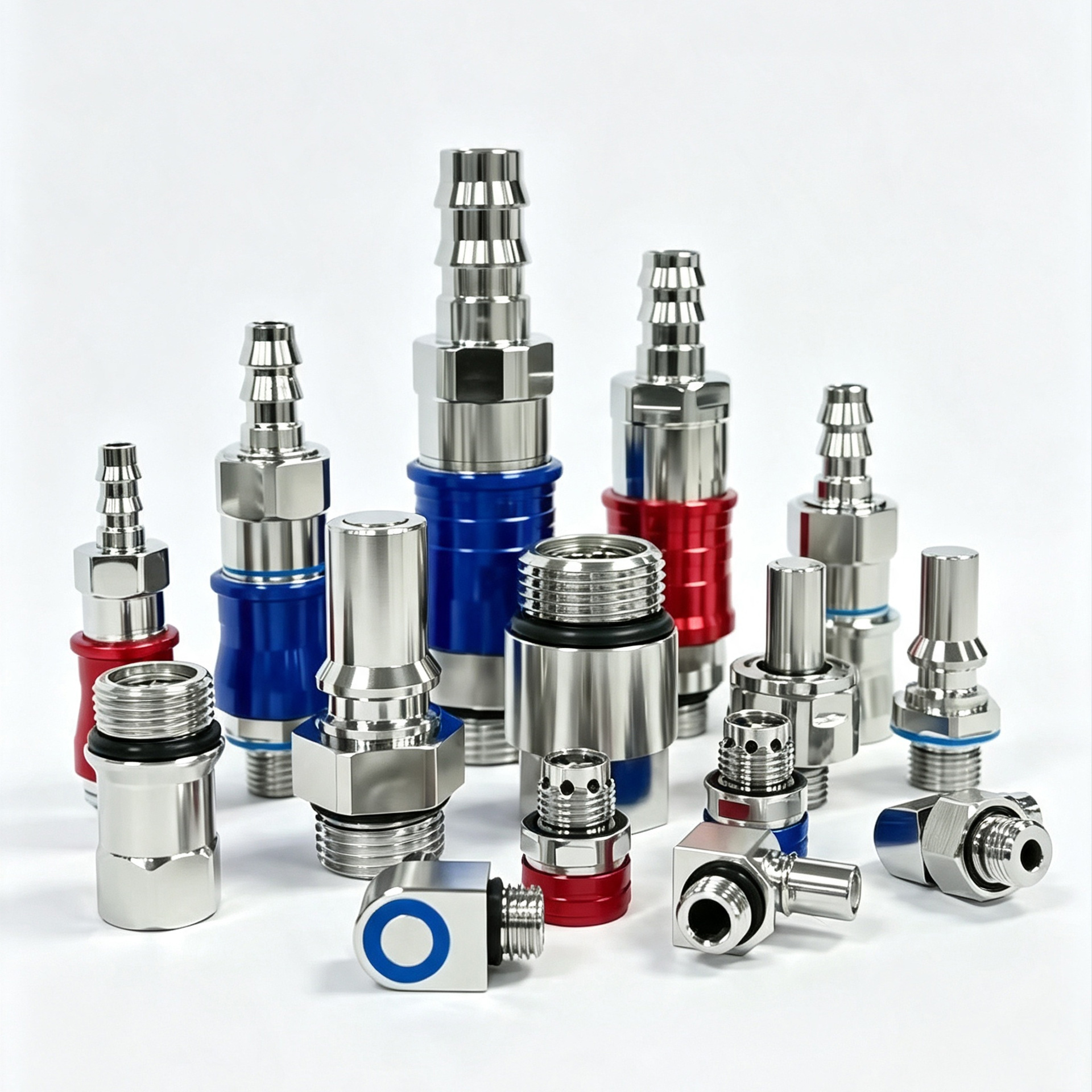
A cooling loop is only as reliable as its cheapest connection. Quick-disconnect couplings let a server tray or a cold-plate assembly be removed and replaced without draining the loop, which is why they have become a standalone procurement item as direct-to-chip liquid cooling moves into mainstream deployments. They are also small, deceptively similar-looking parts where a fraction of a millimetre, the wrong elastomer or a contaminated sealing surface can put liquid where no liquid should be.
This page is the companion to our liquid cooling cold plate page. Same buyer, same rack, often the same shipment, but a different part number and a different main search phrase. A plate is a make-to-drawing thermal component; a coupling is a precision fluid connector with its own interface convention, seal technology and test regime. Keeping them separate avoids self-competition in search while the internal link lets a thermal engineer source both halves of the loop in one conversation.
Open industry specifications describe the interface dimensions and performance expectations that allow blind-mate, low-spill couplings to work across a rack ecosystem. We source compatible parts that are verified against the interface your system uses. We do not claim brand authorisation, we do not print another company’s mark, and we do not treat a dimensional match as proof of performance: sealing, pressure behaviour, insertion force and cycle life all need their own evidence.
The buyers are thermal integrators, server ODMs, liquid-cooling loop assemblers and spare-parts distributors. Their questions are practical: will it mate with the manifold already installed, will the seal survive the coolant chemistry for the service life, what happens after repeated connections, and who owns the interface when the coupling comes from one factory and the plate from another.
Key Specifications
| Item | What we confirm with you |
|---|---|
| Interface and mating | The interface convention, nominal size, blind-mate tolerance and the mating half it must connect to. |
| Sealing and spill | Seal design, low-spill or non-spill behaviour, and the expected condition at disconnect under system pressure. |
| Materials | Body, spring and elastomer materials selected against the actual coolant chemistry and operating temperature. |
| Pressure and flow | Working pressure, proof or burst expectations and the allowable pressure drop across the coupling. |
| Life and cleanliness | Connection cycle expectation, particle and cleanliness limits, and the protective caps used in transit. |
| Test evidence | Per-batch leak test, pressure test and cycle test records tied to a serial or lot identifier. |
We deliberately do not publish a nominal size, pressure rating, cycle count or material recommendation as a universal answer. Those values depend on the interface convention and the coolant actually used in your loop. The configuration is confirmed against your drawing and coolant specification at sample stage and frozen as a controlled revision.
What to Confirm Before Quoting
| Item | What we confirm with you |
|---|---|
| Interface definition | The mating half, interface drawing and tolerance stack for the manifold or tray you are using. |
| Coolant chemistry | The coolant formulation and any additives, plus the operating temperature range. |
| Pressure profile | Working pressure, transient conditions and the proof-test expectation for the assembled loop. |
| Service model | How often trays are disconnected, whether hot maintenance is required, and the expected service life. |
| Cleanliness and packing | Particle limits, cap and bagging requirements, and how the parts reach the assembly line. |
| Quantity and documents | Sample, pilot and repeat quantities, plus the test records and declarations your customer requires. |
Interface ownership is the hidden cost in this category. When the coupling comes from one workshop and the cold plate or manifold from another, a fit problem becomes an argument between suppliers. We put the interface drawing, the tolerance stack and the responsible party in writing before tooling starts, and we return itemised quotations that separate the coupling, the test scope and the packing so bids remain comparable.
Documents and Compliance
| Item | What we confirm with you |
|---|---|
| Interface and dimensional evidence | Approved interface drawing, dimensional inspection records and the revision reference for the exact order. |
| Per-batch performance evidence | Leak, pressure and connection cycle test records with lot-level traceability. |
| Material and medium compatibility | Body and elastomer material declarations, restricted-substance documentation and a written compatibility statement for the stated coolant. |
| Import and shipment | Commercial invoice, packing list, origin documentation and a destination-specific classification determined by a licensed broker. |
A material certificate is not a leak test, and a dimensional report is not evidence that a seal survives the coolant. Keep the four groups separate and insist on lot-level traceability so a field issue can be isolated to one production run. Pressure-bearing assemblies may also fall under equipment rules that depend on the complete system design, not on the component alone. We are a sourcing and freight partner, not a certification body or legal counsel; that determination belongs with a licensed broker or qualified local adviser.
How We Source and Ship It
| Stage | What happens |
|---|---|
| 1 · Interface freeze | We record the mating drawing, coolant, pressure profile and service model in a written specification. |
| 2 · Workshop shortlist | Vetted connector houses are compared on machining capability, cleanliness control and test equipment. |
| 3 · Sample and loop test | Samples are validated on your own manifold or test rig, including repeated connection and leak checks. |
| 4 · Batch and inspection | Production lots carry leak, pressure and cycle records; we inspect cleanliness and protective packing before dispatch. |
| 5 · Consolidated delivery | Couplings can ship with cold plates, tubing and other loop parts as one documented shipment. |
Splitting a liquid loop across factories is normal; splitting accountability is not. Our consolidation process brings the plate, coupling and tubing suppliers under one inspection and paperwork plan, and our packaging work covers caps, bagging and cleanliness preservation in transit so the sealing surfaces arrive in the condition they left the test bench.
Common Sourcing Mistakes
The first mistake is qualifying by shape alone. Two couplings can look identical and differ in tolerance stack, seal geometry or spring force, which shows up as weeping under pressure or excessive insertion force during blind mating. Approve against a controlled drawing and a test rig, not a photograph and a nominal size.
The second is ignoring the coolant. Elastomers that behave well with one formulation can swell, harden or leach into another, and mixed metals in the same loop invite galvanic corrosion. State the chemistry and additives in the specification, require a written compatibility statement, and re-test if the coolant changes. A dimensional match to an open interface convention is also not a brand authorisation; we use our own part numbering and never apply another company’s mark.
Frequently Asked Questions
Can you match the interface used by our existing manifold?
Yes, provided we have the mating drawing or a sample of the installed half. We verify dimensional fit and then validate sealing and repeated connection on a test rig. We do not treat a nominal size or a photograph as sufficient evidence.
How do you handle coolant compatibility?
We record the coolant formulation and additives in the specification, require a written material compatibility statement from the workshop, and keep the seal material as a controlled item. If the chemistry changes, we re-test rather than assuming the previous approval still holds.
What test records come with a production lot?
Leak, pressure and connection-cycle results tied to a lot identifier, together with dimensional inspection records and material declarations. We agree the exact test scope at sample stage so the records match your receiving criteria.
Can these ship with cold plates and tubing?
Yes, and it is usually the better route. Consolidating the loop components into one documented shipment keeps the interface, the inspection plan and the customs paperwork under one accountable party.
Need a Quote? Message Us on WhatsApp
You have reached the end of the product details, so here is the direct line. Send your specification and quantity to our sourcing team and we will come back with comparable quotations, sample options and a shipping plan.
Chat on WhatsApp → Use the Quote Form
WhatsApp and phone: +86 186 7676 3055 | Email: info@cinosourcing.com
Tell us your destination market, the mating interface drawing, the coolant chemistry, the working pressure, the expected connection cycles, the cleanliness requirements and the quantity breaks. A photo of the installed half is enough to start.


Reviews
There are no reviews yet.