
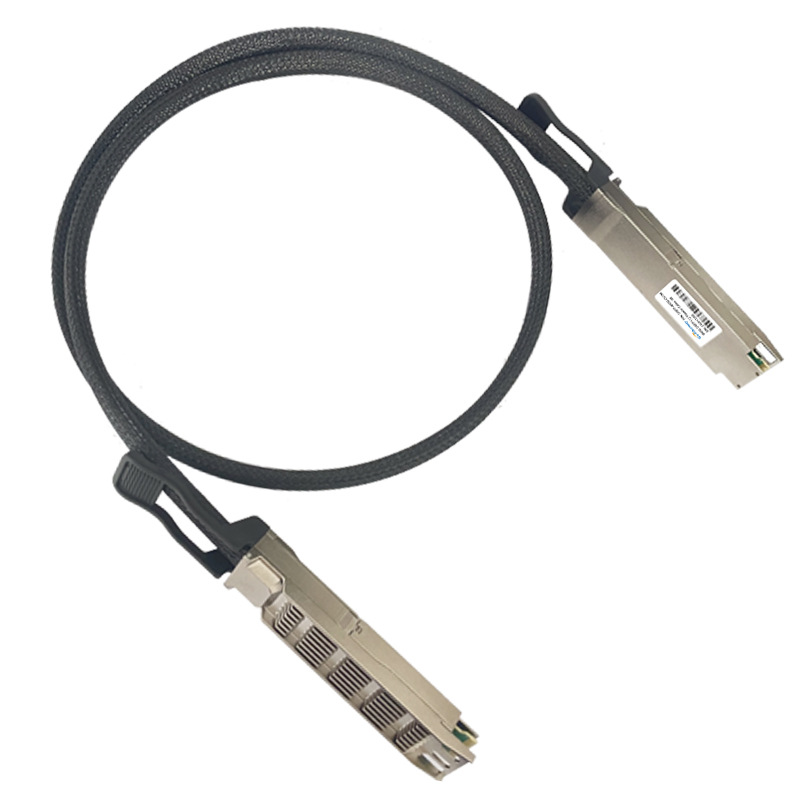
Why This Product Sells
Not every link inside an AI rack needs optics. For the short runs between an accelerator tray and the top-of-rack switch, a factory-terminated copper assembly is still the default: no optical conversion, no extra power draw, lower latency, and a much simpler failure mode. As port speeds climb, those assemblies stop being commodity patch leads and become a qualified part of the network design. A cable that passes on the bench but fails after a bend, a re-seat or a firmware update can take a whole training job down.
The category split is now clear enough to source against. Passive direct-attach copper still dominates the shortest in-rack runs, while active electrical cables with signal-conditioning electronics extend usable reach and are growing faster in GPU clusters. Public market research puts the 2026 data-centre DAC market at roughly one billion US dollars with a low-teens compound growth rate, and reports 800G ports taking a meaningful share of new shipments. Industry cabling guidance describes a layered topology: copper inside the rack, pluggable optics and active optical cables between racks, single-mode fibre beyond the hall. We source the copper layer, not the whole network.
This page deliberately sits beside, not on top of, our 800G optical transceiver page. Search intent is different: a buyer looking for a transceiver is solving a cross-rack optical link, while a buyer looking for a DAC assembly is filling ports inside one cabinet. In practice the same project buys both, often on one purchase order and one shipment. Keeping them as separate pages with separate main phrases means neither competes with the other in search, while the internal links let a real buyer move between them.
The buyers we write for are server and switch OEMs, system integrators, colocation fit-out teams and regional distributors who need a second source for a platform they already deploy. They do not want a gadget review. They want to know whether the assembly will be recognised by their switch, whether a two-metre and a three-metre version behave the same, what evidence ships with each batch, and who is accountable when a compatibility claim turns out to be wrong.
Key Specifications
| Item | What we confirm with you |
|---|---|
| Connector and form factor | The port family and cage style used by your switch, NIC or accelerator tray. Confirmed against your equipment list, not assumed from a rate label. |
| Assembly type | Passive copper, active copper with signal conditioning, or a mixed bill of materials across the same rack. Each has a different power, thermal and reach profile. |
| Length and routing | Per-link length, bend radius, exit direction and slack allowance. Longer is not better; the approved reach depends on the whole channel. |
| Identification and coding | EEPROM content, part numbering, label artwork and packaging marks required for the target platform to recognise the assembly. |
| Electrical evidence | Insertion loss, return loss, crosstalk, impedance consistency and error-rate results for the production batch, not only for a golden sample. |
| Environment | Operating temperature, shielding, jacket material and any exposure to liquid-cooling loops or high-density airflow paths. |
We do not publish a fixed rate, maximum length, power figure or universal compatibility list on this page, because none of those values is meaningful without the exact host platform. Every line above is confirmed in writing at sample stage and frozen as a controlled revision before a batch is released.
What to Confirm Before Quoting
| Item | What we confirm with you |
|---|---|
| Host equipment list | Switch, NIC and accelerator models plus the port type at each end. This determines coding and mechanical fit. |
| Link map | How many links of each length, which racks, and whether the route passes a bend or a liquid-cooling manifold. |
| Passive or active | Whether the link budget needs signal conditioning, and whether the host can supply and cool it. |
| Document set | Which test records, material declarations and labels your receiving inspection or end customer requires. |
| Quantity breaks and samples | Sample quantity, pilot quantity and the intended repeat order, stated separately so tooling and test costs are visible. |
| Destination and delivery | Destination market, required delivery terms and whether the cables ship with optics or other line items. |
A quote for a cable assembly is only comparable when the revision is comparable. Ask each workshop to price the same connector, the same length set, the same coding content and the same test scope. We return itemised quotations so a lower number cannot hide a thinner test plan or an unapproved substitution of wire gauge, shielding or connector housing.
Documents and Compliance
| Item | What we confirm with you |
|---|---|
| Product and platform evidence | Specification sheet, compatible-platform statement and coding definition for the exact model ordered. |
| Batch test evidence | Per-batch signal-integrity and error-rate records with serial-range traceability, plus the factory’s routine test method. |
| Material and environmental | Jacket, shielding and connector material declarations, restricted-substance documentation and any flame-rating requirement for the destination. |
| Import and shipment | Commercial invoice, packing list, origin documentation, and a destination-specific classification determined by a licensed broker. |
These four groups do not substitute for one another. A material declaration is not a compatibility test, and a compatibility test is not a customs ruling. Networked assemblies may also carry additional electromagnetic or firmware-related obligations depending on the market. We are a sourcing and freight partner, not a certification body or legal counsel; the destination determination should be confirmed by a licensed broker or qualified local adviser.
How We Source and Ship It
| Stage | What happens |
|---|---|
| 1 · Specification freeze | We convert your link map into a written specification with connector, length set, coding and test scope. |
| 2 · Workshop shortlist | Vetted assembly houses are compared on test capability, platform experience and traceability, not only unit price. |
| 3 · Sample and host test | Samples go to your own equipment for recognition, link-up and thermal checks. Nothing is released on a supplier’s verbal assurance. |
| 4 · Batch and inspection | A pilot batch is produced under the approved revision, with per-batch records and pre-shipment inspection. |
| 5 · Consolidation and delivery | Cables can be consolidated with optics, cold plates or other line items into one documented shipment under agreed terms. |
Consolidation matters more than it looks. A rack build rarely arrives from one factory, and splitting the bill across several suppliers often means several customs entries, several sets of paperwork and several chances for a missing declaration. Our consolidation process puts the interfaces under one accountable party, and our factory verification checks that the workshop issuing the test records is the one actually building the batch.
Common Sourcing Mistakes
The first common mistake is treating a compatible assembly as an original branded part. Third-party assemblies are a legitimate and widely used supply route, but describing one as an original, applying another company’s mark, or copying its label artwork creates an intellectual-property problem that no test report can fix. We ask every workshop for its own part numbering and a written statement about design ownership.
The second is approving a golden sample and then accepting a different revision in production. Wire gauge, shielding construction, connector housing and retimer firmware all affect behaviour, and a cost-driven substitution can invalidate the compatibility evidence you approved. We make any change subject to written approval and re-testing, and we keep serial ranges so a field problem can be isolated to one production run.
Frequently Asked Questions
Do you supply both passive DAC and active AEC assemblies?
Yes, we source both from vetted assembly houses. Which one is right depends on the link budget, the host platform and the physical route. We will ask for your equipment list and link map before recommending either, and we will not quote a reach figure that has not been validated on your own hardware.
Can you code the assemblies for our switches?
Coding and identification content can be specified as part of the order and verified on your equipment at sample stage. We treat this as a controlled configuration item with its own revision record, because a coding change can be as consequential as a hardware change.
What evidence ships with a production batch?
At minimum the approved specification, per-batch signal-integrity and error-rate records, material declarations and serial-range traceability. The exact set depends on your receiving inspection and destination market, and we agree it in writing before the batch is released.
Can these ship together with transceivers and other rack parts?
Yes. Consolidating the copper, optical and mechanical line items into one documented shipment is often the simplest way to reduce customs entries and handling damage. We can also arrange destination-specific delivery terms; see our sourcing process for how that works.
Need a Quote? Message Us on WhatsApp
You have reached the end of the product details, so here is the direct line. Send your specification and quantity to our sourcing team and we will come back with comparable quotations, sample options and a shipping plan.
Chat on WhatsApp → Use the Quote Form
WhatsApp and phone: +86 186 7676 3055 | Email: info@cinosourcing.com
Tell us your destination market, the host switch or NIC models, the link map and lengths, whether the links need passive or active assemblies, the coding and label requirements, the quantity breaks and the test records your project requires. A port list or a photo of the current cable label is enough to start.


Reviews
There are no reviews yet.