
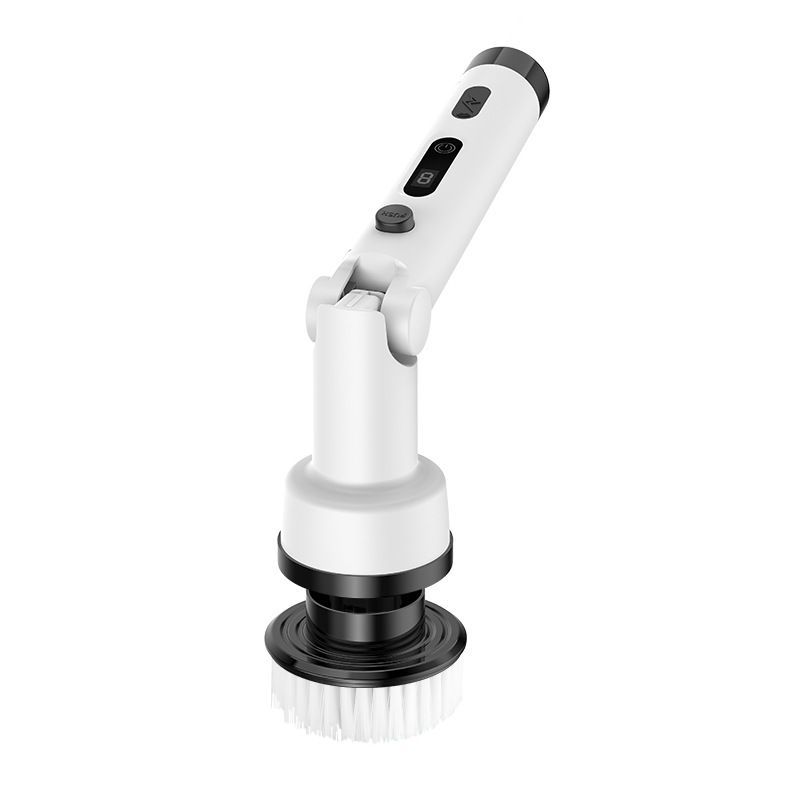
Why This Category Keeps Reappearing
An electric spin scrubber sells the moment a viewer watches a grout line turn white without anyone kneeling down. The rotating head does the repetitive wrist motion, the telescopic pole removes the back strain, and the before-and-after frame does the rest. Short-form cleaning content has taught the use case so thoroughly that a listing barely needs a feature list. Our trending products guide explains why a viral clip is a sourcing question, not a headline.
The buyers behind those views are marketplace sellers testing a first household SKU, cleaning-product distributors, private-label home brands, hospitality suppliers and dropshipping operators who need a one-unit route that can later become a stocked batch. They already believe the demo. What they need to know is whether the hundredth unit still turns under pressure, whether spare heads will exist next season, and whether a rechargeable wet-room appliance can be imported with a defensible document set.
We are a China sourcing agent and freight forwarder, not a brush factory or a retail brand. Every question worth asking here crosses supplier boundaries: which motor and gearbox are fitted, which cell and protection board are inside, whether the ingress claim covers the charging port, whether the spare heads are actually produced, who is the economic operator at destination, and how a lithium-powered appliance clears customs. A factory page describes what it moulds; this page describes what must be true before a batch ships.
What the Search Data Actually Says
The word family has a stable root. Spin scrubber, electric spin scrubber and cordless spin scrubber name the tool itself. Sibling phrases split by room and job: power scrubber, shower scrubber, bathroom cleaner brush and electric cleaning brush. The long tail names the surface and the pain: shower tiles, grout cleaning, bathtub grime, soap scum, a long handle, multiple heads and replacement attachments for tile surfaces.
Third-party Google Trends-derived analysis reports fluctuating but sustained interest in the root phrase, with highs in late summer and again in late winter, and newly visible queries about kitchen use and replaceable brushes. Marketplace-side category data shows interest building into spring and a winter high on a separate normalised index. Those are different terms, windows and scales; they cannot be reconciled into a single growth rate or a monthly search volume, and we will not quote one.
What survives the noise is a shape, not a metric: buyers name the room, the surface and the physical relief, never the speed on the box. That is why this page targets the sourcing phrase and folds every room-specific and feature-specific variation into one page instead of opening a dozen near-duplicate URLs. It sits in our TikTok Viral Hot Picks category.
Naming It Correctly: Spin Scrubber, Not a Rotating Brush
A terminology point changes findability. Sourcing lists often offer “electric rotating cleaning brush” as a direct translation of the Chinese category name, and some export pages add “wireless cleaning brush” for good measure. English buyers say cordless or rechargeable; wireless belongs to networks and charging pads, not to an appliance without a power cord. A title, URL or image alt built on the translated phrase is invisible to the words people actually type.
The second trap is the wet-room claim. Waterproof and water-resistant are not interchangeable, and an ingress rating describes a stated part under stated test conditions. A sealed charging cover, a pole with no electronics and a spinning head are three different assemblies. Moisture in the charging port is a common reason these units stop charging. We print no ingress grade here; we ask for the test evidence, the part it covers and the drying instruction in the manual.
Speed is the third trap. Rotation speed is not torque, and a motor that stalls when the user leans on it is usually hitting overload protection, not failing. A kit described by its accessory count says nothing about behaviour on a grout channel. We print no speed, capacity or runtime. Ask for a versioned sheet naming the test condition, head and mode, then verify it on your own sample. Our pre-shipment inspection service describes how that evidence is captured.
What Buyers Compare Before Approving a Sample
Public review analysis for this category is consistent. The two most concentrated complaints are short battery life and weak motors; close behind come wobble when the extension pole is fitted, heads that seize or detach, moisture in the charging port and no visible way to buy replacements. Hard nylon bristles on glass or acrylic add a scratch complaint no return policy can undo. None of these appear in a catalogue photo, and all are visible in a proper sample protocol.
Ask each workshop to state the motor and gearbox, cell supplier and model, protection board and charger, the head attachment mechanism, bristle material and stiffness by head type, the spare-head supply plan, which parts were covered by any ingress test, and the exact model identifier on every report. Answers should be written, versioned and tied to a golden sample. Our factory verification process covers that evidence trail before a deposit moves.
The accessory set hides a commercial question: a pointed head reaches a grout channel while a flat disc bridges over it, and only a soft pad makes glass safe. Choose the head list from the surfaces in the target market and freeze it as part of the configuration; otherwise the customer blames the tool for the wrong head and the seller absorbs the return.
Three Versions and What They Change Commercially
There is no shared part number across this category. Catalogue platforms list several silhouettes built on public tooling, and each choice moves cost, carton size and failure modes. Settle the drive train, the cell and charging interface, the head list and its retention system, the pole joint, the artwork and the packaging, the destination market and the required documents before anyone quotes a figure.
| Version | What changes commercially | What to verify before approval |
|---|---|---|
| Handheld short-body unit | Fewest parts, lightest parcel, simplest packaging; lowest exposure to pole-joint complaints and the easiest first SKU to test by single-unit fulfilment | Wet-grip stability, head retention under side load, charging cover seal, and whether a soft pad is included for glass |
| Telescopic long-handle unit | Solves the reach story in short video; adds a joint, a locking collar and a longer carton, which changes volumetric freight and damage risk | Pole lock stays seated under scrubbing load, joint play measured on production units, and manual states which parts may get wet |
| Convertible kit with multiple heads | Strongest retail presentation and the widest surface coverage; highest count of small parts, manual pages and spare-part questions | Every head has a stated surface and replacement path, colour and stiffness are frozen, and the box list matches the approved sample exactly |
Two cosmetic-looking requests are engineering decisions. A logo is straightforward, but changing housing colour, bristle stiffness, head geometry or the cell supplier can alter tooling and the validity of existing reports. Label each change as artwork, configuration or hardware before quoting, and get design ownership in writing: public-tooling catalogues contain retail silhouettes that no certificate can legitimise. Our private label guide covers that boundary.
MOQ, Samples and the Route You Are Actually Buying
No single minimum or schedule fits this category, which is why none is printed here. Three different jobs hide behind one word: pulling a stocked configuration, changing artwork and accessories, or developing a new housing and drive train. Each has its own cost curve and its own evidence burden. Ask every workshop to name which job it is quoting and to price the three separately, or the numbers will not be comparable.
| Route | What you actually get | What you take responsibility for |
|---|---|---|
| Stocked public-tooling build | A current housing and component set, a sample from the running line, existing test evidence and the quickest route to a first batch | Locking the configuration, checking that every document names that model, and supplying the destination label set |
| Artwork, packaging or head-set changes | Approved logo files, a retail carton, translated manuals, a revised head list and a spares statement | Sign-off on artwork, carton drop checks, and a rule that no component swap happens without fresh approval |
| New housing, motor or gearbox | Tooling, prototype rounds, a pilot run and a formal approval file | Ownership of the tooling, fresh test evidence, updated declarations, and revision control for the life of the SKU |
If this is your first household SKU, start with single parcels and a short run through our China dropshipping agent service, then scale the same supplier relationship into a consolidated order. A catalogue app cannot offer that continuity because it owns no relationship with the workshop. Our low MOQ guide explains how to frame the factory conversation.
Four Document Families That Do Not Cover Each Other
First orders usually fail on paperwork, not on plastic. The same carton is a lithium consignment, an electrical appliance, a consumer good offered online, and an import with a classification. Workshops tend to hand over one folder and call it compliance. We ask for four separate evidence sets, each tied to one model, one cell configuration and one revision.
| Layer | What it covers | Evidence to request before approval |
|---|---|---|
| Battery transport | Whether a carrier accepts the cell or the appliance that contains it | A test summary tied to the exact pack, a current safety data sheet, the applicable classification and packing instruction, state-of-charge evidence, and confirmation of whether the cell travels installed, alongside or separately |
| Electrical and product safety | Electrical safety, electromagnetic behaviour, restricted substances, the charger and any wet-room claim | Model-matched reports from an accepted laboratory, a declaration of conformity, charger and protection-board data, and substance declarations covering boards, plastics, bristles, coatings and cartons |
| Consumer and market rules | General safety, what an online listing must disclose, who is the responsible operator, producer duties and warnings in local languages | A written decision on manufacturer and importer roles, the operator where one is required, label and manual content, plus separate evidence for waste and battery registrations |
| Import and clearance | Who may legally import the goods, under which classification, and who settles the charges | A classification confirmed by your broker for the finished appliance, a named importer of record, invoice and packing list, and a written allocation of duty and tax under the chosen delivery term |
Keep four distinctions clear. Testing a cell says nothing about the finished appliance. A transport summary gets a carrier to accept a consignment; it does not authorise a sale. And there is no all-purpose consumer certificate that transfers the duties of whichever business places the goods on a market. Have a licensed broker settle the final market position. Our DDP service page shows where the delivery term and importer of record meet.
Two destination rules are easy to miss right now. Direct-to-consumer parcels into the United States no longer enjoy the suspended low-value exemption, so the landed-cost arithmetic has changed; our US de minimis guide walks through it. Selling into the EU means identifying an economic operator and putting the required information in the online offer, while battery and waste obligations are handled under separate rules; our Germany guide covers that side.
Quality Control: Stall, Wobble and Consumable Heads
Most returns in this category trace back to a mismatch between a polished clip and a real bathroom. A head glides across a clean tile on video; the customer pushes it into a greasy corner with a partly discharged cell. Close that gap at sample stage: freeze a reference unit, tie the bill of materials to it, and repeat the same functional checks on the batch rather than admiring a photograph.
| Failure mode | What a visual sample check misses | What to require before release |
|---|---|---|
| Motor stalls under hand pressure | A light pass on a flat tile looks fine; overload behaviour on a corner with a pointed head does not | Loaded run on the agreed surface and head, stall recovery recorded, and a written rule that the manual teaches guiding rather than leaning |
| Pole joint wobble | A short handheld test never exercises the longer lever arm | Fully extended load test, lock-seating check after repeated cycles, and joint-play measurement on production units |
| Head retention and bristle wear | Heads fit on a new unit; limescale, hair wrap and worn collars appear after weeks of wet use | Repeat attach-and-remove cycles, wet soak and re-fit check, bristle shedding check, and a named spare-head SKU with stated availability |
| Ingress and charging port | A damp cloth test says nothing about spray from a shower head or a wet storage hook | Evidence stating which parts were tested, charging-cover seal inspection, and port-drying instruction in every manual language |
| Revision drift | A golden sample cannot tell you which cell, gearbox or head was fitted weeks later | Frozen BOM, recorded serial ranges, a written change-control rule, and pre-shipment sampling with dated photo evidence |
Looking at a unit is not testing it. Ask for the written protocol: sample size, sampling basis, acceptance rule and the action taken when a unit fails. Agree before the deposit who funds rework, who signs the release and who keeps the failed samples. Add one line to the manual telling users to guide the head instead of pressing, and another warning against stiff bristles on glass and acrylic.
Private Label, Packaging and Design Ownership
Branding this category is a paperwork job rather than a decorating job. One approved revision has to hold the logo files, a stable model identifier, the retail carton artwork, manuals in each destination language, the label set carrying contact and electrical information, a soft-surface caution and a statement about replacement heads. Keep that set on file and reuse it verbatim on reorders, so a repeat order is not a fresh interpretation. Our custom packaging guide covers artwork approval upstream.
A carton also has to survive the carrier. Because the tool holds a cell and a long pole changes its geometry, board strength, cushioning, state of charge and markings all come into play, and a retail box that passed a drop test is not automatically a shipping carton. For fulfilment centres, bag the head sets so loose parts are not counted as missing and settle label placement before packing; our FBA preparation service covers that origin-side work.
Lithium Batteries, Consolidation and Shipping
Freight planning starts with how the cell travels. Installed in the handle, packed loose beside the tool, or sent as a separate spare changes the transport classification, the carton marks and the paperwork the carrier will ask to see. Air and sea accept different evidence, and both expect a current test summary plus a safety data sheet describing the pack actually loaded. Check each page against the cell model, pack layout, lab reference and any component substitution since the test date.
Here the freight side changes the economics. Units, spare heads, a carton run and a complementary item from a second workshop can usually be consolidated into one shipment and one customs entry rather than several small parcels each carrying fixed charges; a long pole also changes carton geometry and volumetric weight. That is the bridge from a trial parcel to a stocked order. We arrange the consolidation, export documents, clearance and last-mile delivery, and name the importer of record in writing.
Get a Quote: What to Send
A good enquiry fits in a few lines: which version or a link to the listing you are replacing, the market and channel, the quantity breaks, single-parcel fulfilment versus a consolidated batch, the head list and how many spares you expect to stock, artwork and carton needs, the documents your channel demands, and whether samples come first. A photo or a supplier link is enough for us to begin.
What you get back is a comparison you can act on: quotes from more than one vetted workshop on the same specification, sample logistics, a document check against the named model, an inspection protocol and a freight option. Our job is to own the seams between the housing moulder, the cell supplier, the brush-head workshop, the carton printer and the carrier. Our sourcing process is explained here for first-time buyers. Send an enquiry or use either WhatsApp button on this page.
Three numbers will never appear on this page: a unit price, a transit window and a duty amount, because all three move with your specification, market and volume. Nor will we relabel an unbranded tool as an original part, reproduce another company’s artwork, wave away a registration, or promise a tax-free parcel. Refusing those shortcuts is part of the job.
Frequently Asked Questions
Can you supply a single unit for a dropshipping test? Yes, and we would argue the test is worthless unless the later batch is the same revision. One supplier relationship can cover both the single-parcel trial and the stocked order, with the same golden sample, head set and document pack behind them. Ask us to put the per-order and per-batch cost models next to each other before you commit, so the comparison includes freight and paperwork rather than just a unit figure.
Is a faster speed or a bigger head set always better? No. Speed is not torque, and a stall under pressure is often overload protection doing its job. A flat head bridges over a grout channel, while a pointed head reaches into it; a stiff bristle can mark glass. Judge the sample on the surfaces your customers actually clean, with the head, mode and test condition named in the report.
Do you provide the certificates? We gather the paperwork from the workshop and the test laboratory, sort it into the four layers above, and flag anything naming a different model or an outdated pack. We are not a certification body, we issue nothing, and we offer no legal opinion. A transport summary, a safety report, a declaration and an operator determination answer four different questions, so have a licensed broker or local adviser confirm the final position for your market.
Can you put our logo on it and ship to a fulfilment centre? Yes. At origin we handle approved artwork, a fixed model name, retail boxes, manuals in the required languages, the label set, bagged head sets, carton marks and the inbound booking under the agreed delivery term. Your seller account, listing content and platform-side compliance remain yours, and we state that split in the written scope before any work starts.
What happens if heads or batteries fail after arrival? The defence is built before shipment: a bill of materials frozen to the golden sample, serial ranges recorded, and rework authority agreed in writing. Then a bad run can be isolated instead of turning into an argument about the whole order. Spare-head availability, a named replacement SKU and clear charging-port drying instructions belong in the sample approval, not in the returns inbox.
Need a Quote? Message Us on WhatsApp
You are at the end of the details, so here is the shortest route to a real answer. Tell us the market, the version, the quantity breaks and the paperwork your channel expects; our sourcing team will return comparable quotes, sample choices and a freight plan.
Chat on WhatsApp → Use the Quote Form
WhatsApp and phone: +86 186 7676 3055 | Email: info@cinosourcing.com
It helps to say whether you want a handheld, a long-handle or a convertible kit, which brush heads and spares belong in the set, whether artwork and retail boxes are needed, where the parcels or cartons will land, and which battery, safety and labelling files your channel asks for. A photo, a supplier link or a screenshot of the listing is plenty to start. No obligation and no long form.


Reviews
There are no reviews yet.