
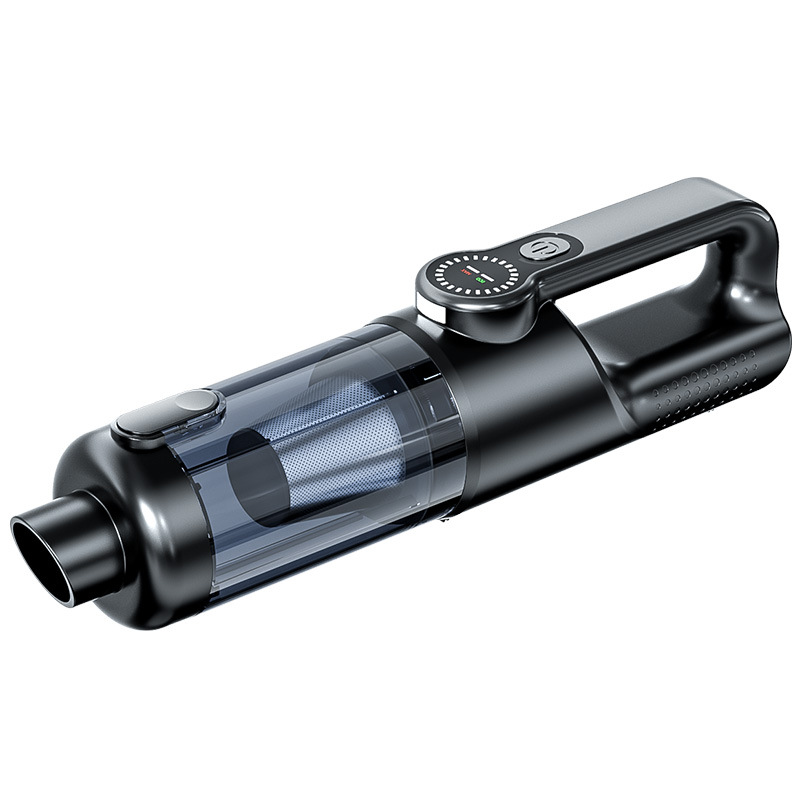
Why This Product Sells
A cordless car vacuum is one of the few products where a ten-second video is the whole sales argument. Sand disappears from a floor mat, crumbs lift out of a seat rail, pet hair clears from a boot liner. The viewer understands the use case without a feature list, which is why short-form commerce keeps pushing this category into seasonal best-seller lists. Our trending products guide explains why a viral clip is a sourcing question rather than a product page headline.
The opportunity is not the video. The product looks simple and is not: a motor, a lithium pack, a charging circuit, a filter, a sealed dust bin and a nozzle set sit inside a palm-sized housing. Each can be swapped to hit a price point, and each swap changes runtime, pickup, return rate and import paperwork. A buyer who approves a sample on suction alone discovers the difference three months later in a returns report.
We are a China sourcing agent and freight forwarder, not a factory or a retail brand. Every question worth asking here is cross-supplier: which cell and protection board are in this unit, does the transport summary describe the pack we are buying, is the declaration for this model revision, who is the economic operator in the destination market, and how does a lithium-powered parcel clear customs. A factory page answers what it makes; this page answers what must be true before a batch.
The audience is narrow: marketplace sellers testing a first SKU, distributors building a private-label car-care line, automotive accessory wholesalers, gift buyers, and dropshipping operators who need a single-unit route that can later become a consolidated shipment. They are comparing three suppliers who all claim to make the same product, and asking who stands behind a batch.
Timing changes the commercial model. Retail attention concentrates in the year-end gifting window and the early-new-year cleaning cycle, while importers lock in tooling, packaging and documents well ahead. That is why we print no unit price and name no guaranteed winner: both would be stale before the first sample is approved.
What the Search Data Actually Says
Search behaviour here has a shape that listings misread. The largest generic phrases are portable car vacuum cleaner and cordless car vacuum cleaner, both consistently outperforming mini car vacuum cleaner in third-party interest analysis. Specification-led phrases and handheld vacuum cleaner for cars register almost no interest. Buyers describe the benefit and the form factor, not the number on the box.
The seasonal picture is less tidy, and worth being honest about. One market-intelligence source reports a sharp two-year rise followed by a recent-six-month cooling and a December gifting peak. A second page from the same source, on a broader phrase, reports a much steeper decline and an April peak. A separate Trends-derived analysis points to a February spike and a September high in the prior year. Different terms, windows and normalisation methods cannot be reconciled into one growth number, and we will not present them as a search volume.
What survives the noise is a direction, not a metric: portable and cordless wording beats mini and specification wording; demand is seasonal; social commerce has already explained the use case. The remaining question is which version, whose documents and which route to the customer. This product sits in our TikTok Viral Hot Picks category.
Cordless, Not Wireless: Naming the Product Correctly
A terminology point changes findability. Chinese sourcing lists commonly use “wireless car vacuum” as a direct translation, but English buyers say cordless or rechargeable handheld. “Wireless” in consumer English attaches to networks and charging pads, not to an appliance without a power cord. Using the translated phrase in a title, URL or image alt makes a page invisible to the phrase people actually type.
The second naming trap is commercial. Suction is advertised in pascals, air watts, cubic feet per minute, or not at all, with no shared measurement condition. Pressure at a sealed inlet with almost no air moving says little about how much debris is carried away. Published test methods exist for suction, airflow and air power, and a cordless-specific performance standard exists as well, but a number without a method, a mode and a nozzle is marketing copy. Boost-mode claims are the sharpest case: the mode behind the headline number may last only minutes, while the mode a customer uses runs longer at a lower setting.
We therefore print no suction value, battery capacity or runtime here. Those belong to one approved revision, one test method and one stated mode. Ask for a versioned specification sheet naming the method, mode, nozzle and battery configuration, then verify it on your own sample with the debris your customers complain about. Our pre-shipment inspection service describes how that evidence is captured.
What Buyers Are Really Comparing
Three things decide whether this product works as a business: the return profile (public reviews repeatedly list weak pickup and short battery life), the filter and dust bin (a washable filter with no replacement path, or a bin that leaks fine dust, turns a five-star sample into a one-star month), and the document set, because a lithium-powered consumer appliance crosses a border under several separate rules at once.
None of these appear in a supplier catalogue; all belong in a written scope of work. Ask each workshop to state the cell supplier and model, protection board, charger, motor type, filter construction and replacement stock, dust-bin sealing method, approved artwork, and the exact model identifier every test report refers to. A supplier who answers precisely is usually worth sampling. Our factory verification process covers that evidence trail before a deposit moves.
Key Specifications and Version Splits
There is no universal part number here. Public-tooling platforms cover several distinct shapes, and the differences are commercial as well as mechanical. Before asking for a price, fix the version, motor type, battery and charging interface, filter and bin design, nozzle set, artwork and packaging, destination market, and the documents your channel requires.
| Version | What changes commercially | What to verify before approval |
|---|---|---|
| Single-function handheld | Fewest parts, simplest packaging, lowest exposure to accessory complaints; easiest to quote per unit and to consolidate | Crevice and brush nozzles actually reach seat rails and cup holders; bin seals when emptied; filter can be washed and replaced |
| Two-in-one vacuum and blower | Adds an air-duster mode that solves vents and dashboard seams; more parts, more instructions, more failure points | Both modes tested on the same sample; mode switching does not loosen the bin; no unapproved airflow claims in the artwork |
| Multi-function kit | Combines suction, blowing, inflation or pumping; strongest short-video demonstration, highest packaging and manual complexity | Each function has a stated acceptance check; accessory count and spare-part list; manual language set for the destination market |
Two requests that look cosmetic are engineering decisions. A logo is straightforward, but a change of housing colour, nozzle geometry, charging port, filter material or battery supplier can affect tooling, yield, thermal behaviour and the validity of existing reports. Ask the workshop to classify each change as artwork, configuration or hardware before quoting. Insist on an unbranded housing from the factory’s own tooling: public-tooling catalogues contain shapes associated with well-known retail products, and no certificate fixes copied silhouettes or labels. Get design ownership in writing; our private label guide covers that boundary.
MOQ, Samples and Lead Time
There is no honest universal number here, so we print none. Quantity and timing depend on how much of the product already exists, and comparing workshops on unit price alone hides what grows later. Ask each one to classify your request into a route below and quote them separately.
| Route | What you actually get | What you take responsibility for |
|---|---|---|
| Existing public-tooling configuration | A stocked housing and component set, a sample from current production, standard test evidence and a short path to a first batch | Confirming the exact configuration, the model identifier on every document, and the destination-market label set |
| Modified artwork, packaging or accessory set | Approved logo files, retail box, manual language versions and a revised nozzle or filter kit | Artwork approval, packaging drop checks, and a written rule that no hardware change happens without re-approval |
| New housing, motor or battery configuration | Tooling, prototype iterations, a pilot run and a structured approval file | Tooling ownership, revised test reports, updated declarations, and lifecycle control of the revision |
For a buyer testing a new SKU, single-unit and small-batch routes are available through our China dropshipping agent service, and the same factory relationship can later carry a consolidated shipment. That continuity is what a catalogue app cannot offer, because it does not own the supplier relationship. Our low MOQ sourcing guide covers the factory side.
Four Document Families That Do Not Cover Each Other
This is where first orders go wrong. A cordless car vacuum is simultaneously a lithium-battery shipment, an electrical appliance, a consumer product sold at a distance, and an imported good with a classification. Suppliers often present one folder of certificates as though it settled all four. We ask for the layers below as separate files, each matched to the exact model, pack and revision.
| Layer | What it covers | Evidence to request before approval |
|---|---|---|
| Battery transport | Whether a carrier will accept the cells or the finished appliance containing them | Test summary for the exact pack, current safety data sheet, correct transport classification and packing instruction, state-of-charge confirmation, and a check of whether the pack ships installed, beside the unit or separately |
| Electrical and product safety | Electrical safety, electromagnetic behaviour, restricted substances and the charger | Model-matched test reports from an accepted laboratory, declaration of conformity, BMS and charger data, restricted-substance declarations covering boards, plastics, coatings and packaging |
| Consumer and market rules | General product safety, online listing information, an identifiable economic operator, end-of-life and battery producer duties, and destination-language warnings | Written determination of who the manufacturer and importer are, the responsible operator where one is required, physical label and manual content, and separate registration evidence for waste and battery obligations |
| Import and clearance | Classification, declared value, duty handling and the legal importer-of-record structure | Broker-confirmed classification for the finished good, a named importer, the commercial invoice and packing list, and a written statement of who pays duties under the chosen delivery term |
Four traps are worth stating plainly. A cell test report does not approve the finished appliance. A laboratory’s acceptance status matters, and an old report only helps if the issuing lab is currently recognised. A transport test summary is a shipping requirement, not a market approval. And no single universal consumer-product certificate replaces the legal duties of the business placing goods on the market. We are a sourcing and freight partner, not a certification body or legal counsel; the destination determination belongs with a licensed broker or qualified local adviser. Our DDP shipping service explains how the delivery term interacts with importer of record.
Two 2026 changes make this worth reading twice. In the United States the low-value parcel exemption has been suspended, so the cost model for shipping one unit direct to a consumer is no longer what it was; our US de minimis guide covers the mechanism. In the European Union the general product safety framework requires an identifiable economic operator and specific information in online offers, while battery and waste duties sit in separate legislation; our Germany sourcing guide covers the destination side.
Quality Control, Returns and the Suction Number Problem
Returns here are rarely about a dramatic defect. They are about a gap between what a short video implied and what the unit does on a fabric seat with a half-empty battery. That gap is measurable at sample stage if the right checks are written into the order. We treat the sample as the reference unit, freeze a bill of materials against it, and require the same checks on the production batch.
| Failure mode | What a visual sample check misses | What to require before release |
|---|---|---|
| Peak-mode suction claim | A short burst on a hard surface looks convincing; performance with a full bin and a low battery does not | Pickup test on the agreed debris and surface, in the mode a customer will use, with the measurement method and nozzle named in the report |
| Runtime and charge behaviour | A sample charged to full hides a weak cell, a slow charger or a protection board that cuts out early | Runtime recorded in the stated mode, charge-cycle check, and a written cell and BMS identity matched to the transport file |
| Filter and dust-bin sealing | Fine dust escaping during emptying only appears after repeated cycles | Repeated empty-and-refill cycles, washable filter with a stated replacement path, and a seal inspection on production units |
| Batch drift | One approved unit says nothing about the cell, motor or nozzle fitted three weeks later | Frozen BOM, serial-range traceability, written change-control rule, and pre-shipment sampling with photo evidence |
A visual inspection is not a functional test, and a factory’s quality system certificate is not a product approval. Ask for the protocol in writing: what is sampled, on what basis, under which acceptance rule, and what happens when a unit fails. Who pays for rework and who authorises shipment afterwards should be agreed before the deposit.
Private Label, Packaging and Design Ownership
Private label here is mostly a document exercise. Logo artwork, a named model identifier, a retail box, destination-language manuals, a label set with required contact and electrical information, and a spare-part statement all have to be approved as one revision. A change to any of them after reports are issued can break the match between paperwork and goods. Keep approved files on record for reorders; the second shipment should reproduce the first without reinterpretation. Our custom packaging guide covers artwork approval upstream.
Packaging also carries a transport function. The unit contains a battery, so the outer carton, cushioning, state of charge and markings all matter to a carrier, and a drop-tested retail box is not automatically a compliant shipping carton. If goods are going into a fulfilment centre, label placement and carton identification must be settled before packing; our FBA preparation service covers that origin-side work.
Lithium Batteries, Packing and Shipping
Shipping is not an afterthought for this SKU. Whether the battery is installed inside the appliance, packed beside it or shipped separately changes the classification, packaging, marks and documents. Air and sea routes differ, and carriers ask for a current test summary and safety data sheet describing the pack actually on board. A folder named “battery certificates” is not evidence: check each file against the cell model, pack configuration, capacity, laboratory reference, and any component change since testing.
Consolidation is where a sourcing and freight partner earns its keep. The vacuum, spare filters, a retail box run and a product from another workshop can often travel as one shipment with one customs entry, instead of four parcels with four sets of fixed charges. That is also where a single-unit test route becomes a batch route. We arrange consolidation, export paperwork, destination clearance and final delivery, and state in writing who is named as importer of record. We quote no freight rate or delivery window on a public page, because both depend on the battery configuration, destination and volume.
Get a Quote: What to Send
A usable request for quotation is short but specific: the version or a link to the current listing, destination market and sales channel, quantity breaks, whether you need single-unit fulfilment or a consolidated batch, artwork and packaging requirements, the documents your channel asks for, and whether you want samples first. A photograph or supplier link is enough to start.
We come back with comparable quotations from vetted workshops, sample arrangements, a document check against the exact model, an inspection plan and a freight option. Our role is to make the interfaces between housing factory, battery supplier, packaging printer and shipping route accountable to one party. Here is how our sourcing process works if you have not used an independent agent before. Get a quote, or use the WhatsApp buttons on this page.
We will not quote a unit price, delivery window or duty amount on a public page, because all three depend on your specification, destination and volume. We will not describe an unbranded product as an original branded part, copy another company’s label artwork, tell you a registration is unnecessary, or claim a low-value parcel is duty-free. Saying no to those things is the service.
Frequently Asked Questions
Can you supply a single unit for a dropshipping test? Yes. The important point is that the single-unit route and a later batch come from the same approved configuration and document set, otherwise the test tells you nothing about the product you will stock. We arrange both from one supplier relationship and show you the per-order and per-batch cost models side by side.
Is a higher suction number always better? No. Figures are quoted in different units and conditions, often only for a short-lived boost mode. Pressure at a sealed inlet is not the airflow that carries debris out of a seat rail. Ask for the method, mode, nozzle and runtime in that mode, and judge the sample on the debris your customers complain about.
Do you provide the certificates? We collect and check the document set from the workshop and laboratory, and tell you which layer each file belongs to. We do not issue certificates and give no legal opinions. A transport summary, an electrical safety report, a declaration of conformity and a consumer-market operator determination are separate things; confirm the final determination with a licensed broker or local adviser.
Can you put our logo on it and ship to a fulfilment centre? Yes, as origin-side preparation: approved artwork, a named model identifier, retail packaging, destination-language manuals and the required label set, then carton labelling and inbound freight under the agreed delivery term. We do not manage your seller account, listing or platform compliance; that stays with you and is stated in the written scope before processing.
What happens if batteries or filters fail after arrival? That is why we freeze the bill of materials against the approved sample, require serial-range traceability, and agree rework authority before the deposit. A problem isolated to one production run can then be identified instead of disputing the whole order. Spare filter availability, a washable filter and a sealed bin belong at sample stage.
Need a Quote? Message Us on WhatsApp
You have reached the end of the product details, so here is the direct line. Send your destination market, the version or link you are sourcing, the quantity breaks and the documents your channel requires, and our sourcing team will come back with comparable quotations, sample options and a shipping plan.
Chat on WhatsApp → Use the Quote Form
WhatsApp and phone: +86 186 7676 3055 | Email: info@cinosourcing.com
Tell us whether you need a single-function, two-in-one or multi-function unit, whether you want private label artwork and retail packaging, which market the parcels or the batch will enter, whether you need samples before a batch, and which battery, safety and labelling documents your channel asks for. A photo, a supplier link or a screenshot of the current listing is enough to start. No obligation, and no long form.


Reviews
There are no reviews yet.