
Why This Product Sells
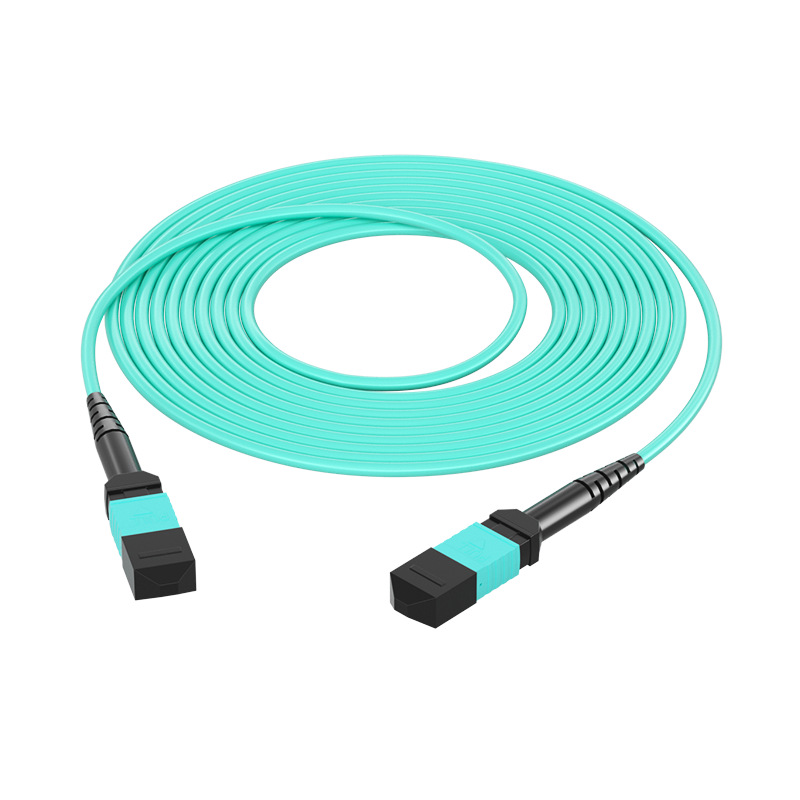
Fibre has quietly become the thing that sets the build schedule. Industry cabling analysis now describes AI racks needing well over a thousand fibres each, with future designs multiplying that again. At that density you cannot splice your way to a finished data hall on site. The default delivery model has shifted to factory pre-terminated trunk assemblies: built, tested, labelled and colour-coded before they leave the workshop, then plugged in rather than terminated in a live aisle.
The procurement question is no longer simply how many fibres fit in a connector. Parallel-optics schemes at higher speeds consume more fibres per link, which pushes trunk counts up and drives smaller multi-fibre connector formats, higher-count backbone cables and strict polarity management. Public industry figures put 2025 growth in data-centre fibre demand at roughly three quarters year on year, with continued strong growth in 2026. Supply-side reporting also notes tightening availability of certain optical components and preform materials, which is exactly the kind of constraint a buyer should know about before a project schedule is fixed.
We are writing this as a sourcing and freight brief, not a fibre-optics tutorial. A trunk assembly is a manufactured, testable item with a defined revision: connector type and gender, fibre count and grade, polarity method, length, jacket rating, end-face condition, label scheme and packaging. Every one of those is a commercial line item, and every one can invalidate the installation if it is quietly changed between sample and batch.
The buyers here are data-centre fit-out contractors, structured-cabling distributors, system integrators and regional importers supplying a named project. They typically arrive with a link schedule rather than a shopping list, and their real concern is accountability: who owns the loss budget, who owns the polarity map, and what happens when a shipment arrives with clean connectors but the wrong gender at one end.
Key Specifications
| Item | What we confirm with you |
|---|---|
| Connector format and gender | Multi-fibre connector type, pin configuration at each end and the mating hardware it will meet in the patch field. |
| Fibre count and grade | Core count per trunk, single-mode or multimode grade, and the performance class required by the link budget. |
| Polarity method | The polarity scheme for the whole channel, agreed as a diagram rather than a letter in isolation. |
| Length and breakout | Trunk length, breakout configuration, pulling-eye provision and slack allowance for the actual route. |
| Optical evidence | Per-assembly insertion loss and return loss results, end-face inspection records and a serial or reel identifier. |
| Jacket, labelling and packing | Flame and smoke rating appropriate to the installation, colour coding, label content, reel or coil method and protective caps. |
None of these values is fixed on this page. A trunk that is correct for one hall is wrong for the next, which is why we do not print a universal loss figure, fibre count or jacket rating here. The approved configuration is frozen in writing at sample stage and referenced on every subsequent order.
What to Confirm Before Quoting
| Item | What we confirm with you |
|---|---|
| Link schedule | The channel map, patch-field layout and the equipment at each end. This defines polarity and gender. |
| Optical budget | The loss budget your design allows and the test method your receiving team will use to verify it. |
| Installation environment | Plenum, riser or general-purpose route, plus any fire and smoke classification required by the destination. |
| Identification | Label content, colour coding, serial scheme and any customer-specific artwork. |
| Quantity and phasing | Sample, pilot and rollout quantities with the delivery sequence, so a phasing error does not stall a hall. |
| Documents and delivery | Required test records, material declarations, packing method and destination-specific delivery terms. |
Ask for itemised quotations that separate the connector hardware, the cable, the termination work, the testing scope and the packaging. Two quotes with the same headline number frequently describe different test coverage. We also make the drawing or channel diagram part of the order, because a polarity misunderstanding discovered after installation is the most expensive kind of error in this category.
Documents and Compliance
| Item | What we confirm with you |
|---|---|
| Configuration evidence | Approved trunk drawing, polarity diagram, bill of materials and the revision reference for the exact order. |
| Per-assembly optical records | Insertion loss and return loss results with a unique identifier for each assembly, plus end-face inspection records. |
| Material and fire documentation | Jacket and connector material declarations, restricted-substance documentation and the fire or smoke classification applicable to the installation. |
| Import and shipment | Commercial invoice, packing list, origin documentation and a destination-specific classification determined by a licensed broker. |
A generic product certificate is not evidence for a specific trunk. The useful document set is per-assembly and per-batch, tied to a serial or reel identifier, so a field failure can be traced back to one production run. Fire and smoke classifications are also installation-specific and country-specific. We are a sourcing and freight partner, not a certification body or legal counsel; the applicable requirements should be confirmed by a licensed broker or qualified local adviser.
How We Source and Ship It
| Stage | What happens |
|---|---|
| 1 · Channel review | We convert your link schedule into a written trunk specification and a polarity diagram. |
| 2 · Workshop shortlist | Vetted pre-termination houses are compared on test equipment, end-face process and traceability. |
| 3 · Sample verification | Sample assemblies are checked against your own test method and mating hardware before approval. |
| 4 · Batch and inspection | Production assemblies carry individual test records, labels and protective caps; we inspect before dispatch. |
| 5 · Packing and delivery | Reel, coil and carton choices are made for the route, with consolidation options for mixed orders. |
Packaging is a technical decision here, not an afterthought. A trunk that arrives with deformed connectors, missing caps or a crushed bend radius fails before it is ever plugged in. Our custom packaging work covers reel choice, end protection, label placement and drop-resistant cartons, and our consolidation service lets fibre, copper and mechanical parts travel as one documented shipment.
Common Sourcing Mistakes
The first mistake is treating polarity as a product attribute instead of a channel property. The same trunk can be right or wrong depending on what it mates with at the far end. Insist on a diagram showing the whole channel and have it signed off before tooling or termination starts; a part number alone does not carry that information.
The second is ignoring cleanliness and end-face condition in the quotation. Inspection, caps, packaging and the receiving test method all cost something, and a supplier who removes them to win on unit price transfers the cost to the installation crew. We make inspection scope and packing standard explicit line items so bids stay comparable.
Frequently Asked Questions
Can you build trunks to our link schedule rather than a catalogue part number?
Yes, that is the normal route for a project order. We convert the channel map into a written specification covering connector gender, fibre count, polarity, length, breakout and labelling, then quote against that frozen revision.
What optical test evidence comes with each assembly?
Each assembly should carry its own insertion loss and return loss result tied to a unique identifier, together with end-face inspection records. The exact test method is agreed with your receiving team at sample stage so the numbers mean the same thing on both sides.
Do you handle fire and smoke ratings for our market?
We collect the jacket and material declarations applicable to the installation and the destination, and we make them part of the order. Which classification is legally required is a destination determination that should be confirmed by a licensed broker or a qualified local adviser.
Can trunk cables ship with copper assemblies and rack hardware?
Yes. Mixed bills of materials are exactly where consolidation helps: one documented shipment, one customs entry where applicable, and one party accountable for the packing and paperwork. Ask us to include it in the quotation.
Need a Quote? Message Us on WhatsApp
You have reached the end of the product details, so here is the direct line. Send your specification and quantity to our sourcing team and we will come back with comparable quotations, sample options and a shipping plan.
Chat on WhatsApp → Use the Quote Form
WhatsApp and phone: +86 186 7676 3055 | Email: info@cinosourcing.com
Tell us your destination market, the link schedule or channel diagram, fibre count and grade, connector gender, polarity method, lengths and labelling, the quantity breaks and the test records your project requires. A patch-field sketch is enough to start.


Reviews
There are no reviews yet.